Park the ticker. Walk out with cash. Isolated books. Ranked LTVs. Revenue buys the meme.
LOAN MEME is a memecoin that owns a lending protocol, not a
protocol that rented a mascot. You post a meme as collateral in its own book
(one market: one meme, one stable), borrow stables against it, and take it
back when you repay.
Nothing is deployed yet, no contracts, no markets, no token
address. Anything circulating today that claims to be LOAN MEME is not ours.
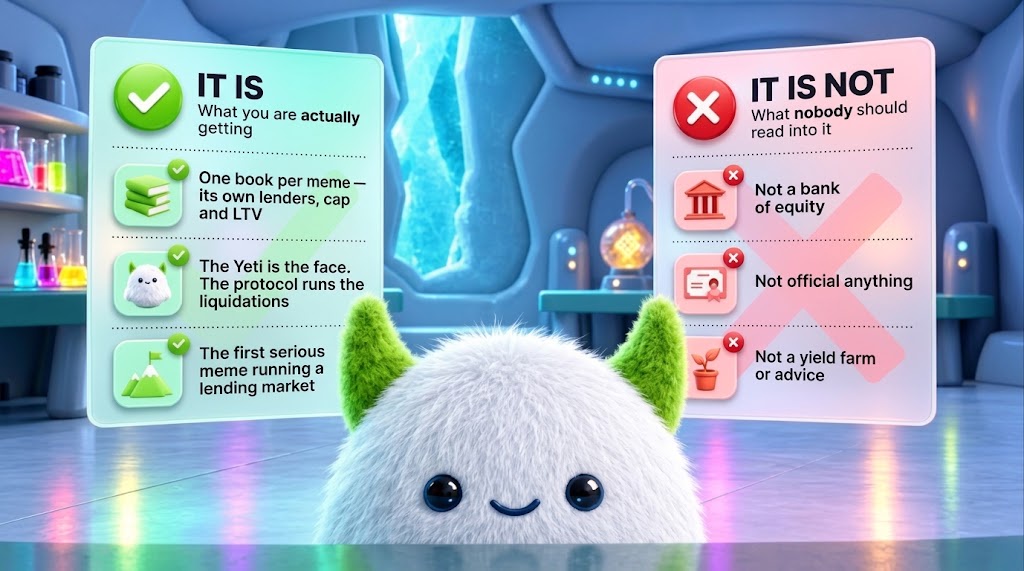
What it is, what it is not
LTV is the share of your meme's value you can borrow, and one meme dying doesn't touch the next book. Deposits are not insured, the token is not a share, no exchange, brokerage or chain endorses or partners with it, and everything here can lose money.
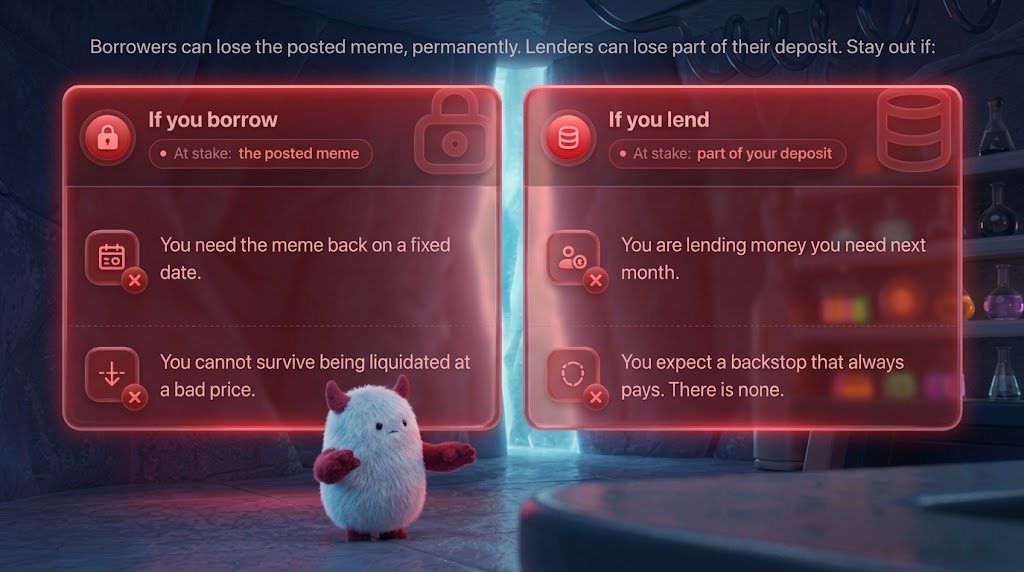
Who should stay out
Videos the Yeti drops a bag (the meme) at the ice window and walks out with a brick (the loan). If they ever disagree with these docs, the docs are right.
Nothing is deployed. This page says what has to be true before each next thing
ships, and lists every parameter still waiting on a number.
Status right now
ContractsNoneNo mainnet or testnet deployment exists.
AuditNot startedNothing is finished enough to audit yet.
TokenNo addressAnything circulating today is not ours.
Books open0No meme has a market.
Total borrowed0There is nothing to borrow from.
Bad debt0Trivially, since nothing is lent.
A status page is not a launch date
The phases below are ordered, not scheduled. We publish a date for a phase
only once the phase before it has closed. A roadmap with dates we cannot keep
is worse than no dates at all.
The phases
Each phase lists what has to be true to leave it. Nothing moves on a calendar, it
moves when the exit criteria are met.
01Parameters signed offwhere we are
Every number in these docs currently marked TBD gets a value, a rationale and an owner.
Exit whenNo TBD is left in these docs
DateTBD
02Testnetpublic
Contracts deployed to a public testnet with at least one book and a working liquidation path.
Exit whenA liquidation has run end to end in public
DateTBD
03Auditexternal
The contracts are audited before any book opens. Until that is done, no parameter above is live and no money is at stake. See Governance and parameters.
Exit whenThe audit is complete
DateTBD
04Mainnet, caps lowfirst books
One chain, a small number of books, borrow caps set well under what pool depth alone would allow. Senior vault only.
Exit whenCaps hold through a real drawdown
DateTBD
05T3 books and the junior vaultif it holds
Thin books open, and with them the junior tranche. This is the phase that can be cancelled: if the waterfall on Senior and junior cannot be built so that junior losses stay inside their own book, junior does not ship and T3 stays closed.
Exit whenTranching audited separately
May not shipSaid plainly, not quietly dropped
06More chainslater
A second chain only after the first has been through a full cycle including at least one liquidation cascade. The chains table on Oracle and listing stays empty until each one is actually live.
Deposit a listed meme. Borrow stables against it, up to what its league allows.
Interest runs while the loan is open. Repay and get the meme back.
The four steps
One position, start to finish. Every book has two sides: lenders put stables in,
you put the meme in and take stables out. Steps 1 and 2 happen in the same
transaction. Step 3 runs on its own until you do step 4.
Fig. 1 One position, four stages. No due date: it stays open until you repay or get liquidated.
01Depositmeme in
You send a listed meme into its own book (its own wallet). It stays locked there. It is not lent out, not staked and not used to farm anything.
You sendThe meme
You getA borrow limit
02Borrowstables out
The book values your meme at its TWAP: the average price in its main pool over a time window, not the last trade. You can borrow up to a set share of that value, the max LTV of the ticker's league. Borrow less and the meme has room to drop. A 2.5% origination fee comes off what you receive: borrow $10,000 and you get $9,750, and owe $10,000.
Your limitMeme value × league max LTV
You getUSD or the chain stable, less 2.5%
03Pay interestdebt grows
Interest is added to your debt as time passes, at that book's borrow rate. Nothing is due on a schedule. The debt just grows, and the loan drifts toward liquidation even at a flat price.
RateVariable, per book
Due dateNone
04Repaymeme back
Pay back the stables plus interest, plus a 2.5% repayment fee on what you repay, and the meme unlocks.
You sendStables + interest + 2.5%
You getThe meme back
There is no repayment date
The loan stays open as long as it stays healthy. What ends it early is price and interest, not a calendar. See Liquidations.
Health factor
One number tells you how close you are to liquidation. At 1 or above you are fine. Below 1, anyone can liquidate you.
health factor=(collateral value×liquidation threshold) / debt
HF ≥ 1 → fineHF < 1 → liquidatable
Fig. 2 The four things that move your health factor. Two of them are yours to control; the other two happen whether you are watching or not.
Collateral value uses the TWAP, not the last trade. A one block wick does not liquidate you, and it does not save you either.
The liquidation threshold comes from the league. If the ticker drops a league, the tighter threshold applies to your open loan once the change takes effect. Notice period TBD
Your debt grows with interest, so a loan you never touch drifts toward liquidation even at a flat price.
You raise HF two ways: repay some debt, or add more of the same meme.
What you cannot do
Borrow memes. Memes only go in as collateral. What comes out is stables.
Borrow 70% against a two day old ticker. New tickers start in T3, the lowest limit. A good wallet score adds +5 LTV points at most, never +20.
Get a higher LTV because of who is promoting the token. Rank is set on the token. See Leagues.
Open a new borrow while the ticker's pool is too thin. That book pauses new borrows until the pool recovers. Repaying still works. See the pause rule.
Use MEME_A to back a borrow in the MEME_B book. Every book stands alone.
The risk, on this page
You can lose the deposited meme
If the price falls far enough, or interest piles up, anyone can liquidate you.
They repay part of your debt and take that much of your meme, plus a 12%
bonus (10 to 15% depending on the book). You keep the stables you
borrowed. The meme they took does not come back, even if the price recovers an
hour later. There is no warning, no grace period and no appeal.
Leagues and rank
Your LTV is ranked on the token first, not on the influencer promoting it.
LTV is the share of your meme's value you can borrow. Every listed meme sits in a
league, and the league sets two numbers for its book: the max LTV, and the
liquidation threshold, the level where your loan can be liquidated. A two day old
ticker with a thin pool does not get the terms of one that has survived a year
with real depth.
A higher league means better terms, not a safer meme. T1 tickers dump too.
The three leagues
TBD, the ranges below are the working
shape, not signed off parameters. Final values land here before the first market
opens.
League
Who gets in
Max LTV
Liquidation
Cap on borrow
T3
New ticker, thin book. Meets the minimum listing bar and nothing more.
~30%
~38%
Small
T2
Has age, has real volume, LP locked.
~45 to 50%
~58%
Medium
T1
Survivor. Deep book, mint authority dead.
~55 to 60%
~65%
Larger
Note
All these numbers are estimates. Each meme will have its own dedicated
numbers and mathematics, shown in our app.
What moves a ticker up
Age. Time on chain without an incident. There is no shortcut.
Depth in its main pool. Enough liquidity that liquidating the book's full borrow cap does not crash the price.
Real volume, held over time. Not one day of fake trades.
LP locked, verifiably, for a meaningful term.
Mint and freeze authority revoked. Required to be listed at all. Nothing moves up without it.
What never moves LTV
Does not count
Tweets, follower counts, engagement.
"We are partners with…"
Team or treasury allocation size.
A listing on a centralised venue.
Paying us. There is no paid tier.
Being a friend of the protocol.
Counts
Pool depth you can measure on chain.
Days since deploy.
Realised volume over a window.
Locked LP, with the lock verifiable.
Authorities revoked.
Survival through a real drawdown.
Borrow caps and pool depth
The league sets your LTV. The borrow cap sets how much the book as a whole can
carry, and it is not a judgement call: it is derived from the canonical pool's
depth, because the pool is where every liquidation has to be sold.
The requirement is that liquidating the book's entire outstanding debt at
once should still be a trade a liquidator would take. That means the sale has to
clear under the break-even slippage from the floor, with
margin.
Borrow cap against pool depthinputs TBD
cap ≤ depthpool × κleague κ = ( starget / (1 − starget) ) / (1 + b)
depth is the value of the meme side of the canonical pool. starget is the most slippage a full-book liquidation may cause. b is the liquidation bonus. The second line is just the first solved for a constant-product pool. The formula is settled; starget is not yet set for any league.
League
Slippage target
κ, cap as a share of pool depth
T1
TBD
derived from starget
T2
TBD
derived from starget
T3
TBD
derived from starget
The slippage target is the only free choice here; once it is set, κ follows
from the formula. The constraint it has to satisfy is that a full-book liquidation
still clears, which means starget has to sit under the break-even
slippage the liquidation bonus can absorb. See
the floor.
Lower leagues will get a smaller share of depth, not because thin pools deserve
punishment, but because their depth is less reliable: a thin pool can halve
overnight, and the cap has to survive the gap between recomputations. That ordering
is settled even though the values are not.
How often it is recomputed
On a scheduleDaily, from the pool's depth averaged over the preceding window rather than its depth at one instant.
On a league changeImmediately, since κ changes with the league.
Downward, any timeLowering a cap is a fast-class change with no timelock, because it cannot make an existing position worse. See Governance and parameters.
UpwardStandard class, with the full delay. Raising a cap adds risk, so it waits.
What happens when the cap is hit
New borrows in that book pause. Only that book, and only borrowing.
It clears by itself as borrowers repay, or when the cap is raised through the timelock.
A cap cut can put a book over its cap without liquidating anyone. Existing loans run on untouched; the book simply stays closed to new borrowing until debt falls back under.
Borrow cap is not utilisation cap
The borrow cap is an absolute ceiling on debt, set by the pool. Utilisation is
the ratio of borrowed to supplied, and it gates lender withdrawals and sets the
rate. A book can be at 100% utilisation and nowhere near its cap, if lenders
have simply not supplied much. See Interest rates.
Moving down
Everything that moves a ticker up can move it back down: depth leaves, volume was
fake, an LP lock lapses, an authority reappears. A demotion tightens the liquidation
threshold on every open loan in that book, so it can make you
liquidatable without the price moving at all.
There is a notice period before it takes effect, and the mechanics, the timelock
class and what happens to existing positions are on
League demotion. If a ticker stops meeting the listing bar
entirely, the book is wound down rather than demoted: see
Delisting and wind-down.
One formula, four numbers per book. The rate is not set by anyone day to day: it
is a function of how much of the book is borrowed right now.
The formula is settled. The numbers are not.
Everything on this page that is an equation is the intended design. Every
value that goes into it — base rate, kink, slope 1, slope 2 — is
TBD. The one exception is the reserve
factor, which is set at 20%. Where any other number appears
below it is there to show the arithmetic working, not to state a parameter.
Utilisation drives everything
Utilisation is the share of a book's stables that is currently out on loan. It is
the only input to the borrow rate.
Utilisationexact
U = borrowed / (borrowed + available)
All in the book's loan asset. A book with 700,000 USD lent out and 300,000 sitting free is at U = 0.70.
The rate curve
The borrow rate is a two-slope line with a kink at a target utilisation. Below the
kink the rate rises gently, because we want the book used. Above it the rate rises
steeply, because the last stables in a book are the ones lenders need to be able to
withdraw, and the only lever that frees them is making the debt expensive.
Borrow rateinputs TBD
if U ≤ Ukink borrowAPR = base + (U / Ukink) × slope1
if U > Ukink borrowAPR = base + slope1 + ((U − Ukink) / (1 − Ukink)) × slope2
At U = 0 the rate is base. At the kink it is base + slope1. At U = 1 it is base + slope1 + slope2, which is the maximum rate the book can charge.
Fig. R1 The shape, not the values. The kink sits where the league's parameters put it, which is not yet decided. The steep leg above it is the mechanism that gets lenders their money back, so the thinner the book the steeper it has to be.
What lenders earn
Interest paid by borrowers is split between the lenders in that book and the
protocol. The protocol's cut is the reserve factor. Everything
else goes to the lenders, spread over the whole book, including the part that is
not currently lent out.
Lender rateinputs TBD
supplyAPR = borrowAPR × U × (1 − reserveFactor)
The × U is why an idle book pays almost nothing: only the borrowed part earns, but the yield is shared across every deposit. See Lenders.
The arithmetic, with the 20% reserve factor and arbitrary inputs for the other two
terms: a book at U = 0.70 and a borrow rate of 12% would pay lenders
12% × 0.70 × 0.80 = 6.72%, and route 1.68% of the book to the protocol.
The utilisation and the borrow rate are not decided values.
How interest is added
There is no payment schedule. Interest compounds into your debt continuously, by a
per-second index. Your debt is not stored as a number of stables, it is stored as a
share of that index, so every open loan accrues without anyone touching it.
Δt is the number of seconds since the last time the book was touched. 31,536,000 is seconds in a 365-day year. The index only moves forward, so a book nobody interacts with for a week still charges that week.
APR and APY, and which one you see
APR is the rate before compounding. APY is what you actually end up paying or
earning once the per-second compounding is applied. This conversion is arithmetic,
not a parameter: it holds whatever the league values turn out to be.
APR to APYexact
APY = (1 + APR / 31,536,000)31,536,000 − 1
A 12% APR is a 12.75% APY. A 60% APR is an 82.2% APY. The gap widens fast, which is why the two are never used interchangeably in these docs.
The app shows APY on both sides
Borrow cost and lender yield are both displayed as APY, because that is the
number you actually experience. Where a figure in these docs is an APR it says
so. The contracts store an APR; the interface converts it.
Per-league defaults
Four numbers per league, none of them set yet, plus the reserve factor, which is
20% in every league. The table below is the shape the sign-off has to fill in, and
the rate columns are published empty rather than filled with a guess.
League
Base
Kink
Slope 1
Slope 2
Max rate
Reserve factor
T1
TBD
TBD
TBD
TBD
base + slope 1 + slope 2
20%
T2
TBD
TBD
TBD
TBD
base + slope 1 + slope 2
20%
T3
TBD
TBD
TBD
TBD
base + slope 1 + slope 2
20%
All values will be APR. The one property the set has to satisfy is directional: the
thinner and newer the book, the lower the kink and the steeper slope 2, because a
thin book cannot afford to sit pinned at full utilisation while lenders wait. That
constraint is settled even though the numbers are not.
A flat price can still liquidate you
Interest is added to your debt, so your health factor falls even when the meme
has not moved. How long a loan survives on a flat chart is set entirely by the
rate and the gap between max LTV and the liquidation threshold, which is why
those numbers are the ones worth arguing about.
See Worked examples.
Every fee the protocol charges, in one table, with a number in every row. Where a
fee is zero it says zero rather than going unmentioned.
The whole list
Nothing charges a fee that is not on this table. If you find a charge that is not
listed here, it is a bug and we want to hear about it.
Fee
Rate
Deposit fee
2.5%
Withdrawal fee
2.5%
Origination fee
2.5%
Repayment fee
2.5%
Reserve factor
20%
Liquidation bonus
12% of repaid debt (10–15% by book)
Liquidation protocol share
10% of that bonus
Listing fee
0
Performance fee on lender yield
0
Where the money actually goes
There are three sources of protocol revenue: the 2.5% fee on every deposit,
withdrawal, borrow and repayment; the 20% reserve factor on borrow interest; and
10% of the liquidation bonus. All three land in the book they came from, and all
three serve that book's reserve before anything leaves.
Fig. F1 Fees are per book. A book with bad debt outstanding routes nothing to buybacks until the hole is closed, so a loss in one book cannot be papered over with another book's revenue.
Costs that are not our fees
These cost you money but none of it reaches the protocol. We list them because
leaving them out is how a fee table becomes dishonest.
Gas. Paid to the chain on every deposit, borrow, repay and withdrawal.
Swap slippage. If you sell the borrowed stables, or buy them back to repay, the price you get is the market's, not ours.
The liquidator's bonus. The part that does not go to the reserve goes to whoever liquidated you. It is a cost of being liquidated, not a protocol fee, and it is set out on Liquidations.
The spread on the loan asset. Acquiring or exiting USD has its own cost wherever you do it.
Fees cannot be changed quietly
Every fee on this page is a timelocked parameter, enforced by the audited
contract. A change is announced before it takes effect, and every change is
logged on
Governance and parameters.
Three positions, carried through with every number shown: one that ends well, one
that gets liquidated, and one that leaves a hole. You can check the arithmetic.
These are illustrations, not listings
MEME_A, MEME_B and MEME_C are stand-ins. No ticker is listed, no book exists,
and every parameter used below — the LTVs, the thresholds, the rates, the
close factor — is
TBD, picked here only so the arithmetic
has something to run on. The fees are the real ones from
Fees: 2.5% to borrow and 2.5% to repay, the 20% reserve
factor, and the 12% bonus with 10% of it to the reserve. The method is what is
fixed, not the values. Change any input and every figure downstream
moves.
1. A healthy loan, open to repaid
MEME_A, a T1 book: max LTV 60%, liquidation threshold 65%, borrow
rate 6.30% APR at the book's current utilisation, reserve factor 20%.
Step
What happens
Numbers
Deposit
100,000 MEME_A into the book, valued at the TWAP of $2.40
Collateral = 100,000 × $2.40 = $240,000
Borrow limit
The league's max LTV is 60%
$240,000 × 0.60 = $144,000
Borrow
You take well under the limit, on purpose
$100,000 USD, an LTV of 41.7%
Origination fee
2.5% of the borrow, taken from what you receive
You receive $97,500 and owe $100,000
Health factor
Threshold is 65%, not the 60% borrow limit
(240,000 × 0.65) / 100,000 = 1.56
90 days pass
Interest compounds per second at 6.30% APR
100,000 × e0.063 × 90/365 = $101,565.55
Interest split
$1,565.55 of interest, 20% of it to the reserve
Lenders $1,252.44, reserve $313.11
Price drifts down
MEME_A TWAP is $2.10 when you come back
Collateral = $210,000
Health factor now
Lower on both sides, still comfortable
(210,000 × 0.65) / 101,565.55 = 1.34
Repay
You pay the debt in full, plus the 2.5% repayment fee, and the book unlocks the meme
$101,565.55 + $2,539.14 = $104,104.69, get 100,000 MEME_A back
The loan cost $6,604.69: $1,565.55 of interest, which is 1.57% of
the principal over 90 days or 6.50% APY, plus $5,039.14 in origination and
repayment fees. Each fee is charged once, however long the loan stays open, so on a
90-day loan the fees are most of the cost. The meme fell 12.5% while the loan was open and nothing
happened, because the position was opened at 41.7% LTV rather than at the 60%
ceiling. That gap is the entire reason this example ends with the meme coming back.
2. A liquidation
MEME_B, a T2 book: max LTV 50%, liquidation threshold 58%, borrow
rate 15% APR, liquidation bonus 12%, close factor 50%, protocol share of the bonus
10%. Same borrower behaviour as above, but closer to the limit and on a thinner
book.
Step
What happens
Numbers
Open
5,000,000 MEME_B at a TWAP of $0.0200, borrow $48,000, receive $46,800 after the 2.5% fee
Collateral $100,000, LTV 48%
Health factor
Only 8 points of threshold above the borrow
(100,000 × 0.58) / 48,000 = 1.21
60 days pass
Interest at 15% APR
Debt = $49,198.27
Price falls 20%
TWAP prints $0.0160
Collateral = $80,000
Health factor
Below 1. From this block, anyone can liquidate.
(80,000 × 0.58) / 49,198.27 = 0.943
Repay
A liquidator repays the close factor, half the debt. The repayment fee does not apply to a liquidation.
R = $24,599.14
Seize
They take that value plus the 12% bonus, priced at the same TWAP
$24,599.14 × 1.12 = $27,551.03 = 1,721,940 MEME_B
Bonus split
The $2,951.90 bonus is split, and it comes out of the seizure, not out of extra collateral
Borrower−$2,951.90184,494 MEME_B taken over and above the debt cleared. They keep the $46,800 they received at open and still owe $24,599.14.
Liquidator+$1,170.92After handing 10% of the bonus to the reserve, selling the rest of the seized meme at 5% slippage and paying 0.5% in gas and flashloan cost.
Lenders±$0$24,599.14 of stables came back into the book. Nothing was lost. The reserve gained $295.19.
The liquidation worked because 12% sits inside both bounds at this threshold: the
ceiling at L = 0.58 is 1/0.58 − 1 = 72%, and the floor at 5% exit slippage is
about 5.8%. Health factor went up, from 0.943 to 1.24, which is the whole
point. See the two bounds.
3. A bad debt event
MEME_C, a T3 book: max LTV 30%, liquidation threshold 38%, borrow
rate 14% APR, bonus 12%. The borrower did nothing unusual. The token gapped.
Step
What happens
Numbers
Open
20,000,000 MEME_C at a TWAP of $0.0050, borrow $29,000, receive $28,275 after the 2.5% fee
Collateral $100,000, HF 1.31
16 days pass
Interest at 14% APR
Debt = $29,178.52
The token gaps
MEME_C falls 76% in under an hour. The TWAP lags, then prints $0.0012.
Collateral = $24,000
Health factor
Far below 1, and the collateral no longer covers the debt at all
(24,000 × 0.38) / 29,178.52 = 0.31
Maximum a liquidator can repay
They cannot seize more meme than exists, so the repay is capped by the collateral itself
$24,000 / 1.12 = $21,428.57
Seize
Every remaining token goes. The borrower's collateral is now zero.
20,000,000 MEME_C
What is left
Debt with nothing behind it. This is bad debt.
$29,178.52 − $21,428.57 = $7,749.95
Where the $7,749.95 lands
The loss is absorbed in the order set out on Bad debt: the
book's reserve first, then junior, then senior. This book is T3, so senior was
never in it.
Layer
Capacity
Absorbs
Left to absorb
MEME_C book reserve
$2,400
$2,400, all of it
$5,349.95
Junior, in this book
$120,000
$5,349.95
$0
Senior
Not present
$0
$0
Junior's stake in the MEME_C book falls from $120,000 to $114,650.05, a
4.46% write-down on that book's junior share price. A junior
depositor whose vault had $600,000 spread over several books sees the vault's share
price fall 0.89%, because only the MEME_C slice was hit. A lender
who never had exposure to MEME_C loses nothing at all.
And if nobody liquidates
The example above assumes a liquidator turns up. At 8% exit slippage one does:
selling $24,000 of MEME_C nets $22,080 against a $21,428.57 repay and $107 of
costs, for $544 of profit. At 25% slippage, which is the realistic number for a
token that just fell 76%, the same trade loses $3,536 and nobody clears
it. The position then sits there, interest still accruing, until either
the price recovers or the book is wound down. Bad debt of $7,749.95 was the
good outcome.
Checking these yourself
Every figure above is reproducible from the formulas on Interest
rates and How a loan works. Two things to know if you are
rebuilding them against the contracts rather than a calculator:
Work in integers. The contracts hold balances as token base units and rates in ray, meaning 27 decimals. Reproduce the arithmetic in BigInt, not floating point, or you will disagree with the chain in the last few digits and chase it for an afternoon.
Rounding is directional. Debt rounds up and collateral rounds down, always against the borrower and never against the book. Over a single position the difference is dust; it is deliberate.
The TWAP is the price, everywhere. Health factor, borrow limit and the seizure in a liquidation all use the same window, read in the same block. There is no second price anywhere in the system.
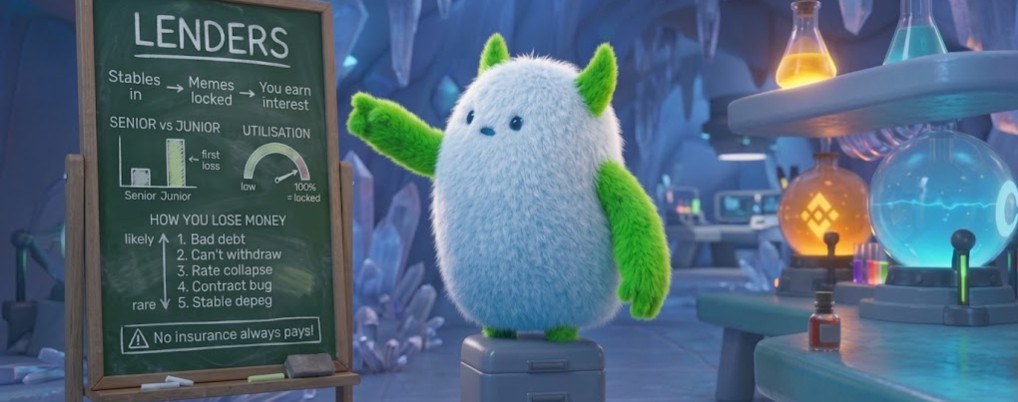
You put stables in. Borrowers put memes in and pay you interest. This page says
how it works.
Where your USD goes
You deposit the loan asset: USD or the chain stable, depending on the
deployment. It sits in a book and is lent to borrowers who have locked that book's
meme against it. Your return is the interest they pay, minus the protocol's 20%
share. Depositing and withdrawing each cost 2.5%. See Fees.
You are only exposed to the books you lend into. A book you are not in cannot cost
you anything. Which books you are in is your choice at deposit, and it is the
only exposure you have.
Senior and junior, in short
Two claims on the same book, in a fixed order: junior is written down first and
paid more for it. The summary is below; the waterfall, the subordination cap, the
rate split and the wipeout case are all on
Senior and junior.
TBD, ships only if we can build it right
Senior
Junior
Lends into
T1 books only
Any league, T1 to T3
Losses
A T1 book going bad. Rarer, not impossible.
Takes the first loss. New and thin books are where memes die.
Rate
Expected lower
Expected higher
Who it is for
You want interest on stables and accept smart contract risk and the odd bad T1 book.
You accept being first in line when a thin meme book goes bad, and that you can lose part of your deposit.
You can lose money in junior
That is what junior is. If a T2 or T3 book ends up with bad debt after
liquidation, junior lenders take that loss. The higher rate is the payment for
it. If you are not comfortable being first in line on thin memecoin books, lend
in senior or somewhere else.
Utilisation and getting your money out
Utilisation is the share of a book's stables that is borrowed right now. It sets
the borrow rate and it decides whether you can withdraw right now.
Low utilisation. Plenty of free stables, you can withdraw, your rate is low.
High utilisation. Rates rise, which pays you more and pushes borrowers to repay.
At 100%. There is nothing free to withdraw. You wait for a repayment or for new deposits. The book is not broke and nothing is bugged, but your money is stuck until then.
Junior has two extra gates. A withdrawal cooldown, and the subordination cap: taking junior out of a book that is at its senior limit is blocked until senior leaves too. See Deposits and withdrawals.
How you lose money, in order of likelihood
Ordered by how often it happens, not by how much it costs. The two do not line up:
the most likely loss is not the largest, and the largest sits near the bottom.
The badge on each row says what is actually at stake.
Most likely
01
Bad debt in a book you lend intoDeposit
A meme gaps down faster than liquidations can keep up, the collateral no longer covers the debt, and the gap lands on that book's lenders. Lenders in other books lose nothing.
TriggerA price gap through the liquidation point
HitsThe vault lending to that book: junior for T2 and T3, senior for T1
You losePart of your deposit
02
You cannot withdraw when you want toAccess
Utilisation is pinned at 100% and you are locked in at exactly the moment you want out. Your balance is intact. You just cannot reach it until a borrower repays or new deposits arrive.
TriggerUtilisation at 100%
HitsEvery lender in that book
You loseAccess, not your deposit
03
Rate collapseYield
Borrowers repay, utilisation drops, and you earn close to nothing while your stables sit idle. Nothing has gone wrong. The book is simply not being used.
TriggerBorrow demand dries up
HitsEvery lender in that book
You loseYield, not your deposit
04
Smart contract failureDeposit
A bug in the market, the locker that holds the memes, the price feed or the fee router. Unlikely, and by far the worst: it can take everything, and it does not care which vault you are in or which league the book was.
TriggerA bug or an exploit
HitsSenior and junior alike
You losePotentially all of it
05
The stable loses its pegDeposit
You hold the loan asset. If USD or the chain stable stops being worth $1, that is your loss, and nothing in this protocol offsets it. The book still balances, in a token that is worth less.
TriggerLoan asset loses its peg
HitsEvery lender, every book
You loseValue of the deposit
Least likely
There is no insurance fund that always pays
A reserve exists per book, funded from that book's own revenue, and it covers
a few percent of that book's debt. It absorbs small losses before lenders are
touched. It is not a guarantee, it is not a backstop for a large event, and we
will not describe it as one. See The reserve.
Two claims on the same book, in a fixed order. Junior is paid more because junior
is written down first. This page is the order, the cap, the rate split, and the
case where junior runs out.
This may not ship
Tranching is the most original thing in this protocol and the least common in
DeFi lending, which means it is the part with the fewest other people's
mistakes to learn from. It ships only if the waterfall below can be built so
that a junior loss stays inside the book it happened in. If it cannot, junior
does not launch, T3 books stay closed, and we say so here rather than shipping
a weaker version under the same name.
Why two tranches at all
A single lender pool over memecoin books has one price for a very wide range of
risk. The lender who wants 5% on stables and the lender who wants 20% and knows
what they are buying both get the same blended number, and the first one is
quietly funding the second one's upside. Splitting the claim lets each price their
own risk.
This is closer to private credit than to Aave. Aave mutualises losses across the
whole pool and backstops them with a staked module. Morpho, Euler and Silo
socialise losses per market with no backstop at all. Here the loss is per book,
and ordered inside the book. See What makes us different.
The loss waterfall
When a book ends up with bad debt, the shortfall is absorbed in this order, and
only ever by money that was in that book.
Fig. T1 The waterfall runs inside one book. Junior is subordinated to senior in the book they are both in, and nowhere else. Junior money in the MEME_C book does not stand behind senior money in the MEME_A book.
Junior does not backstop across books
This is the question worth being precise about, because the answer changes what you
are buying.
What junior does
Takes the first loss in every book it is allocated to, down to zero, before senior in that same book loses a cent.
Gets paid a higher rate in that book for doing it.
Can be allocated to books in any league, including T1.
What junior does not do
Cover losses in a book it never funded.
Act as a protocol-wide insurance fund. There is no such thing here.
Get topped up by profits from other books after a write-down.
Which books each tranche may enter
Senior
Junior
May be allocated to
T1 books only
Any league, T1 through T3
Position in the book
Paid last in loss, paid first in interest
Written down first, paid the residual
Expected rate
Lower, and less variable
Higher, and it can be negative in a bad month
Loses money when
A T1 book's loss is bigger than all the junior in it
Any book it is in takes any loss at all
Withdrawal
Subject to free liquidity
Subject to free liquidity and the subordination cap and cooldown below
Who it is for
You want interest on stables, accept smart contract risk, and accept that a T1 meme can still die badly enough to eat through junior.
You are pricing memecoin credit risk on purpose, you understand you are first in line, and you can lose most or all of the deposit.
The junior-to-senior cap
Senior's protection is only as thick as the junior sitting under it, so a book
cannot take unlimited senior money against a thin junior layer. Every book carries
a maximum ratio.
Subordination capinputs TBD
seniorbook ≤ Rmax × juniorbook Rmax: TBD
The ratio decides how much of a book's lender capital can be lost before senior is touched at all. A lower ratio makes senior safer and junior's yield smaller, because there is less senior money paying junior for the protection. That trade-off is the decision; the number is not made yet.
What the cap does in practice:
New senior deposits are refused into a book already at the cap. The deposit is not queued and nothing fails silently: the book is simply closed to senior until more junior arrives.
Junior withdrawals are blocked if taking the money out would push the book over the cap. This is the most important thing to understand before depositing junior: your exit can be gated by senior's presence, not only by utilisation.
A breach from a loss does not force-liquidate anyone. If a write-down pushes the ratio past the cap, the book stops accepting senior and stops opening new borrows until it is back inside. Existing positions run on.
How the rate is split
The book earns one number: borrower interest, minus the reserve factor, as set out
on Interest rates. That number is then split. Senior is paid
its share first; junior takes whatever is left.
Interest splitinputs TBD
I = supplyAPRbook × (senior + junior)
senior gets = I × senior/(senior+junior) × (1 − d)
junior gets = I − senior gets
d is the subordination discount: the slice of senior's pro-rata interest that is handed to junior as payment for standing in front of it. Value TBD.
Worked: one book, one year
Illustrative only, to show how the split behaves. A book with $400,000 senior and
$100,000 junior at a 4:1 ratio, paying lenders a blended 8%, with the discount set
to 25%. None of those inputs is a decided value.
Capital
Pro-rata interest
Actually paid
Rate
Senior
$400,000
$32,000
$24,000
6.00%
Junior
$100,000
$8,000
$16,000
16.00%
Book total
$500,000
$40,000
$40,000
8.00%
Junior earns 16% instead of 8% because $8,000 a year is transferred from senior.
That $8,000 is the price senior pays for a $100,000 buffer. Change the discount and
every number in the last two columns moves; the mechanism does not. Whether it is a
good trade depends on how often the buffer is used, which is what
Risks is for.
The same book, with a loss
Shortfall in the book
Reserve absorbs
Junior absorbs
Senior absorbs
Junior share price
$5,000
$5,000
$0
$0
Unchanged
$35,000
$5,000
$30,000
$0
−30%
$105,000
$5,000
$100,000, all of it
$0
Zero
$135,000
$5,000
$100,000, all of it
$30,000, or −7.5%
Zero
Assuming a $5,000 reserve in the book. Senior's first cent of loss arrives only in the fourth row.
When junior is wiped out
A junior share price of zero is not a rounding problem, it is a terminal state for
that tranche in that book. The following happens automatically, in the same
transaction as the write-down.
The junior tranche in that book is closed. No new junior deposits, because there is no positive share price to mint against. Existing junior holders in that book hold a claim worth zero, and it does not recover if the book later earns.
New borrows pause in that book, under the same mechanism as the pool-depth pause. Repayments, withdrawals and liquidations all keep working. See Emergency procedures.
Senior becomes the first-loss layer for anything further in that book, and is told so: the book is flagged in the interface and in the subgraph, and senior withdrawals are not gated while it is in this state.
The book is scheduled for wind-down unless a fresh junior tranche is created and funded. See Delisting and wind-down.
Junior losses are realised, not deferred
There is no mechanism by which later interest in the same book restores a
written-down junior holder, and none by which another book's profit does. If
you want the write-down to be recoverable, you want senior.
Deposits and withdrawals
Senior
Junior
Deposit
Any time, unless the book is at the subordination cap
Any time
Deposit fee
2.5%
2.5%
Withdrawal fee
2.5%
2.5%
Withdraw, liquidity
Limited to the book's free stables
Limited to the book's free stables
Withdraw, cap
Not gated by the ratio
Blocked if it would push the book past Rmax
Cooldown
None
Length TBD. It exists so junior cannot exit into a gap the moment a price starts moving.
Withdraw while paused
Yes, to the extent stables are free
Yes, to the extent stables are free and the cap allows
The junior cooldown exists for one reason: without it, the first junior depositor
to notice a meme wobbling exits at par and leaves the remaining junior holders
carrying a loss that was, at the moment they were both in, shared. A cooldown makes
that race unwinnable rather than merely unfair.
Open design questions
Published because they are not settled, and because a docs page that hides them is
worse than useless to anyone deciding whether to lend.
Should senior be allowed into T2 books?
Today senior is T1 only. The argument for opening T2 is that a T2 book with a full junior layer under it may genuinely be safer than a T1 book at the cap, and the league is a crude proxy. The argument against is that it makes senior's risk depend on a second variable that a depositor now has to track per book. Unresolved.
Should the discount d vary by league?
A single flat discount would pay junior the same premium for standing in front of a T1 book as a T3 book, which under-prices T3 junior. A per-league discount fixes that and adds a parameter per book to govern. Leaning towards per-league, not decided.
Can one deposit be junior in one book and senior in another?
Mechanically yes, since the tranche is a property of the position in a book rather than of the depositor. Whether the interface should encourage it is a separate question. For now each deposit picks one tranche in one book, or goes through a vault that does the allocating.
Sometimes the collateral runs out before the debt does. This page is what happens
next: when the loss is recognised, who absorbs it, in what order, and what your
share price does the moment it lands.
What counts as bad debt
Bad debt is debt with no collateral behind it. Not a position that is merely
underwater, and not a position nobody has liquidated yet: those are unhealthy
positions, and they can recover. Bad debt is what is left when a liquidator has
taken the last token and the debt is still not zero.
Bad debtexact
badDebt = debt − collateralValue, once collateralTokens = 0
While collateralTokens > 0 there is still something to seize, so the position is unhealthy rather than bad. The two are counted and reported separately.
Two numbers, published separately
A book reports both, because reporting only the second is how a protocol looks
solvent right up until it is not.
Unrealised shortfallMarked, not written downThe sum, across open positions, of debt above collateral value. It has not touched anyone's share price. It can go back to zero if the price recovers.
Realised bad debtWritten downThe sum of shortfalls on positions whose collateral is gone. It has already hit the share price of the lenders in that book. It does not recover.
When the loss is recognised
Immediately, in the same transaction as the final liquidation. Not
carried, not amortised, not parked in a ledger to be dealt with later.
The reason is that any delay creates a race. If a book has a known hole and the
share price still says otherwise, the lenders who withdraw first get out whole and
the ones who were slow carry the whole loss. Recognising it on the spot means the
share price is true at every block, and everyone still in the book at the moment
the collateral ran out shares the loss in proportion.
There is still a window, and we will not pretend otherwise
Between the price gapping and the final liquidation clearing, the shortfall is
unrealised, and a lender who withdraws in that window escapes a loss the rest
will take. Three things narrow it: liquidation is permissionless so anyone can
close the position, the shortfall is published the whole time so nobody is
withdrawing on private information, and junior deposits carry a cooldown so the
tranche that takes the first loss cannot exit into the gap. It is narrowed, not
closed.
The order of absorption
Three layers, in this order, all of them inside the book that took the loss. The
waterfall diagram is on Senior and junior.
Order
Layer
Capacity
What it does to you
1
The book's reserve
Whatever that book has accrued, capped at its balance
Nothing. Lenders do not notice a loss this size.
2
Junior, in this book
The full junior balance in that book, down to zero
Senior share price falls. Only reachable once junior is at zero.
The reserve is a per-book buffer funded out of that book's own revenue, as set out
on Fees. It is drawn automatically, in the transaction that
realises the loss, with no approval step and no discretion. Its target size is
TBD, and whatever that number turns out to
be, it is a buffer against small losses and not insurance against large ones.
What it does to your share price
Lender deposits are held as shares in a book, priced against the book's total
assets. Writing down bad debt reduces total assets without changing the share
count, so the price per share falls. Nothing is taken from your wallet; each share
is simply worth less.
Per book, per tranche. A withdrawal at the new price returns fewer stables for the same shares.
A 4.46% write-down on a junior tranche means 1,000 shares that were worth $1,000
are worth $955.40. The shares are still yours and they keep earning; they are
earning on a smaller base.
Worked, end to end
The full arithmetic is example 3 on Worked examples.
Every figure below is illustrative: the parameters it uses are not signed off.
Amount
Note
Debt outstanding
$29,178.52
After 16 days of interest at an illustrative 14% APR
Collateral left, at TWAP
$24,000
MEME_C fell 76%
Most a liquidator can repay
$21,428.57
$24,000 / 1.12, because they cannot seize more meme than exists
Bad debt realised
$7,749.95
Written down in the liquidating transaction
Reserve absorbs
$2,400
The whole reserve balance for that book
Junior absorbs
$5,349.95
4.46% off the junior share price in that book
Senior absorbs
$0
T3 book, senior was never allowed in
The reserve is not a backstop and we will not call it one
Whatever the reserve target is set to, it will be a few percent of a book's
debt. The event that actually hurts a memecoin book is a 40 to 80% gap, and
against that the reserve is a rounding error. It exists to stop small losses
reaching lenders, not to make lenders whole. Anyone describing it as insurance,
including us on a bad day, is wrong.
After a book takes bad debt
All buyback routing from that book stops. Every cent of that book's revenue rebuilds the reserve until it is back at target. A book carrying realised bad debt never contributes to a buyback. See The $LOAN Flywheel.
The book is flagged in the interface and on chain, with the realised figure and the date.
New borrows pause if junior was wiped out. If junior survived, the book keeps running and the pause rule on Emergency procedures applies as normal.
The event is written up. What happened, what the parameters were, what we changed. Published whether or not anyone asks.
Price comes from a TWAP of the canonical pool, not the last tick. If the pool is
empty, new borrows pause. A ticker only gets a book if it passes every listing
check.
Why TWAP, not last tick
The last tick is the price of the last trade in the pool. On a memecoin it is cheap
to move. If collateral were priced off it, anyone could pump the price, borrow
against the fake value and walk, or dump it and liquidate someone else for the
bonus.
So every book prices its meme with a TWAP, a time weighted average price: the
average price in the pool over a set window. To move a TWAP you have to hold the
price away from the market for the whole window, which costs real money and gives
everyone else time to trade against you.
SourceThe canonical pool: the one main pool for that token on the chain where the book lives, named at listing.
MethodTime weighted average price over a fixed window, set per league. Window length TBD, see Oracle specification below.
Not usedThe last tick. Prices from other pools or exchanges. Any price we cannot rebuild from chain data.
TradeoffA TWAP lags. In a fast dump it shows a price higher than the real one, which delays liquidation and makes bad debt more likely. That is the cost of a price that is expensive to manipulate, and it is one reason the LTVs are low.
Oracle specification
"We use a TWAP" is a decision, not a parameter set. On memecoins the oracle is the
single most likely point of failure, so every number that defines it belongs here.
Window and cadence
League
TWAP window
Minimum observation cardinality
Reasoning
T1
TBD
TBD
Deepest pool, manipulation is most expensive, so this gets the shortest window and the freshest price.
T2
TBD
TBD
Middle ground.
T3
TBD
TBD
Thinnest pool and cheapest to push, so this gets the longest window: an attacker has to hold the price away from the market for all of it.
Cardinality is how many historical observations the pool stores. A
pool that keeps too few cannot serve a window as long as we need, and the oracle
read reverts rather than silently returning a shorter window. Cardinality is
checked at listing and rechecked on every league change; if it is insufficient, the
protocol grows it itself and pays the gas, once, at listing.
Who updatesNobody has to. The TWAP is read from the pool's own accumulator at the moment of the call, so it is computed fresh on every borrow, every health-factor read and every liquidation.
CadenceThere is no publishing cadence and no keeper to bribe or to fail. There is also no poke, so nothing goes stale through neglect.
Cost of that choiceEvery read costs gas, and the price is only as good as the pool's last trade activity.
Staleness
A TWAP read from an accumulator cannot be stale in the usual sense, but it can be
built on observations that are all very old, which is the same problem wearing a
different hat. A pool nobody has traded in for hours reports a confident average of
a price that no longer exists.
Staleness testinputs TBD
stale ≡ (now − lastObservationTimestamp) > staleAfter
staleAfter: TBD, expected to be defined as a multiple of that league's window rather than as an absolute number of seconds
On a stale read, in this order:
New borrows in that book pause immediately. Nobody can take on debt against a price we do not trust.
Liquidations pause too. This is the uncomfortable half of the rule: a stale price is as likely to liquidate someone wrongly as to miss a liquidation, and we would rather carry the risk than seize a borrower's meme on a price we have just declared untrustworthy.
Repayments and withdrawals keep working. Both shrink the book's risk, and neither needs a reliable price to be safe.
The book un-pauses on its own as soon as a fresh observation lands. No human step, no multisig transaction.
Deviation circuit breaker
A single read that jumps further than a plausible market move is treated as an
attack until proven otherwise.
A breach pauses new borrows and liquidations in that book for one full window. If the move is real, the second window confirms it and the book reopens at the new price. If it was manipulation, the attacker has paid to hold a price for two windows and got nothing for it.
A circuit breaker delays liquidations, which costs lenders
Pausing liquidations for a window on a genuine 30% crash means the book eats a
window's worth of further downside before anyone can act. That is a real cost
and it is the price of not being drained by a price that was never real. The
deviation bound is set where it is because on a memecoin the second failure is
more likely than the first.
When the canonical pool dies or moves
The canonical pool is named at listing and is the only price source for that book.
Memecoin liquidity migrates: a new pool opens on a different AMM, the old one
drains, and the book is left pricing collateral off a pool with nothing in it. The
procedure is deliberately slow, because a fast pool-swap is an attack vector wearing
a helpful face.
Detection. Pool liquidity below the book's minimum for a sustained period, not at a single instant. The check is the same one used at listing.
New borrows pause. Automatic, no human input. The book keeps accepting repayments, withdrawals and liquidations while the price is still trustworthy.
A replacement is proposed through the normal parameter process on Governance and parameters, with the new pool address, its depth, and the price difference between old and new published before anything changes.
The timelock runs in full. An oracle source change is in the slowest parameter class. Nobody can repoint a book's price feed quickly, including us, including in an emergency.
If no acceptable pool exists, the book is wound down rather than repointed at a bad one. See Delisting and wind-down.
If the pool is drained mid-liquidation
A liquidator seizes meme at the TWAP and then has to sell it. If the pool empties
between those two moments the liquidator eats the difference, not the book. The
protocol never promises an exit price.
The seizure itself is priced at the TWAP read in the liquidating transaction, so the book's accounting is settled before any selling happens.
A liquidator using the callback flow on the liquidator guide finds out inside the same transaction and can simply revert, which costs gas and nothing else.
What the book loses in this scenario is not money, it is a liquidator: the position stays open, and the book is now in the no-bonus-clears state.
What we do not use, and why
Not used
Why not
The last tick
Cheap to move on a memecoin. One trade could set the borrow limit.
A Chainlink or Chronicle feed
There is no professional feed for a two-week-old meme, and there never will be. This is the trade that makes the whole protocol possible and it is also its biggest weakness. Aave rejects DEX TWAPs as a primary source for exactly this reason; we are pricing assets Aave would not list at all.
A median across several pools
Considered. It fails on memecoins because the second and third pools are usually too thin to median against, and a thin pool in the median is an attack surface rather than a safeguard.
An off-chain or signed price
Anything we cannot rebuild from chain data ourselves is something you have to trust us about.
Listing checklist
A ticker gets a book only if every line is true. Not most of them.
Mint authority revoked. If someone can still print more supply, we do not list it. No exceptions.
Freeze authority revoked. A meme someone else can freeze is not collateral.
A canonical pool named at listing, deep enough to absorb a liquidation of the book's full borrow cap.
Minimum liquidity in that pool, measured over a window, not at a single moment. TBD
Minimum age for the league it enters. TBD
A normal token. No balances that change on their own, no tax on transfers, nothing that can block a transfer during a liquidation.
A borrow cap set from the pool's real depth, low at first.
Listed means the meme can be used as collateral. It does not mean the meme is safe to hold.
Authorities, and what we check
Check
Why it matters
If it fails
Mint authority
Whoever holds it can print new supply and crash the price of every meme locked in the book.
Not listed
Freeze authority
A frozen token cannot be taken in a liquidation, so the debt can never be recovered.
Not listed
LP lock
Unlocked liquidity can be pulled out of the pool in the middle of a liquidation.
Capped at T3, or not listed
Upgradeable token
If someone can change how the token works after listing, every check we ran means nothing.
Not listed
Big holders
One wallet large enough to dump through the pool sets the real worst case.
Lower league, lower cap
Chains
Memes from Robinhood Chain, Base, BSC and Solana can live in the LOAN MEME
universe. A market only exists on a chain where we have actually deployed, and
this table only lists chains that are live.
Chain
Markets live
Status
No chain yet
None
Nothing deployed yet
The table above stays empty until a deployment exists
We do not list a chain we have not shipped on, and we are not affiliated with
any chain operator, exchange or brokerage. A meme originating on a given chain
may end up listed as collateral; that is not a relationship with anyone.
When your health factor drops below 1, anyone can repay part of your debt and take
that much of your meme, plus a bonus. If the meme gaps down too fast for that, the
loss stays in that book.
What a liquidation looks like
Three sides are involved: you, the liquidator, and the lenders in that book. Anyone
can be the liquidator. No permission, no queue.
01HF drops below 1price falls
The TWAP updates and your meme is worth less, or interest has pushed your debt up. Your health factor crosses below 1, and from that moment anyone can liquidate the loan.
Measured onThe TWAP, not the last tick
WarningNone
02Debt repaidstables in
A liquidator repays part of your debt in stables. Those stables go back into the book, to its lenders.
If your health factor is back at 1 or above, it stops there. If not, the loan can be liquidated again, straight away.
HF 1 or aboveIt stops
HF still below 1Liquidated again
The bonus, and the two bounds it sits between
The bonus is a fixed 12% of the repaid debt, set between 10 and 15% per book. That
is one number, and the thing it has to satisfy is not one condition but two, only one
of which holds still. It is worth showing the arithmetic rather than asserting that
the number is fine.
Write C for the collateral tokens, P for the oracle price, L
for the liquidation threshold, D for the debt, R for the amount
repaid in one call, and b for the bonus.
Notationexact
HF = C · P · L / D Cseized = R (1 + b) / P
The ceiling: a liquidation must leave the book healthier
That is the entire job. If seizing collateral makes the health factor
worse, every liquidation drags the position further under and the mechanism
is working against itself.
The ceilingexact
HF′ = L (C·P − R(1 + b)) / (D − R) > HF
⇐⇒ 1 + b < HF / L
At the moment of liquidation HF = 1, so the binding condition is simply b < 1/L − 1.
Liquidation threshold
Highest bonus that still helps
A fixed 15% is
0.38 T3
163.2%
Far inside. Not the binding constraint here.
0.58 T2
72.4%
Comfortable.
0.65 T1
53.8%
Comfortable.
0.80
25.0%
Still fine.
0.85
17.6%
Inside, but not by much.
0.90
11.1%
Self-defeating. Every liquidation pushes the health factor down.
The league thresholds on Leagues and rank are well under
0.80, so the ceiling is unlikely to be what binds. It becomes the binding constraint the moment anyone proposes a high-LTV
league, and it is the reason a stablecoin-style 0.90 threshold can never be bolted
onto a 15% bonus.
The floor: somebody has to want the trade
The liquidator repays R, sells the seized meme at slippage s, and
pays g in gas and financing. Below a certain bonus the trade loses money and
no rational bot takes it.
The floorexact
b > (1 + g/R) / (1 − s) − 1
Unlike the ceiling, this bound moves every block, because s depends on how deep the canonical pool is right now and how much is being dumped into it.
Fig. L1 The minimum bonus a liquidator will accept, against exit slippage, with gas and financing at 0.5% of the repay. The shaded area is where a bonus satisfies both bounds. Illustrative, at a 0.85 liquidation threshold.
What the chart says
A fixed 10% stops attracting liquidators once exit slippage passes about 8.6%. The 12% default holds to about 10.3%, and a fixed 15% to about 12.6%.
Above roughly 14.5% slippage no bonus satisfies both bounds at a 0.85 threshold. The floor has risen above the ceiling and the window has closed. The only remaining exits are a smaller close factor, splitting the liquidation across several blocks, or bad debt.
A constant sits correctly between a moving floor and a fixed ceiling at exactly one depth. Everywhere else it is either paying more than it needs to, or not enough to get the job done.
The bonus is set at 12% of the repaid debt, with a range of 10 to 15% by book.
This chart is the reason it stays a parameter worth revisiting rather than a
settled choice.
Fixed bonus, or reverse auction
Both models end with the same debt repaid. They differ in who decides what the
liquidation costs: the parameter file, or the bidders.
Fig. L2 Under a fixed bonus the competition is for transaction ordering, which is why the surplus leaks to the block builder rather than staying in the book. Under an auction the competition is on price, and the winning bid is the market's own estimate of what the liquidation costs.
An auction turns the bonus into a discovered price. It opens at zero and rises until
a bidder's profit turns positive, which is precisely the floor from the chart above.
Everything between that clearing point and the fixed number is value the fixed model
gives away by construction.
Fig. L3 An illustrative ramp, 0 to 20% over five minutes, against the fixed 12%, at 5% exit slippage. The gap between the two lines at the clearing point is the value the fixed model hands over.
Fixed 12% pays$1,200On a $10,000 liquidation, from the first block, regardless of depth.
Auction clears at$579The bonus that actually makes the trade worth doing at 5% slippage.
Difference$621Stays in the borrower's collateral. It is the same $621 that lands on junior when a seizure is what tips a book into bad debt.
The cost of the auction is latency. The position stays underwater while the ramp
runs, which is a real risk on a meme that gaps 40% inside a minute: 87 seconds of
price discovery can be 87 seconds during which the collateral stops covering the
debt at all. Price discovery against time to close is the trade, and it is
the decision this protocol has not yet made.
What gets published, either way
If the fixed bonus stays
The liquidation threshold per league with the ceiling check shown, as in the table above.
The slippage depth each book's bonus, 12% by default, is priced for, and the pool depth that implies.
A worked example at the boundary, not on a comfortable position.
If it becomes an auction
Start bonus and cap.
Ramp length, and whether it steps per block or per second.
Whether bidding is permissioned. It will not be.
Either way, what happens when no bonus clears gets documented rather than
left in a footnote. That path ends in bad debt, and it has its own page:
Bad debt.
When no liquidator turns up
This is the failure mode that actually costs lenders money, and it is not
hypothetical. A meme that has just fallen 70% has wide spreads and thin depth
exactly when the protocol needs someone to absorb a large sale.
The position sits. It is liquidatable, nobody liquidates, and interest keeps accruing on top. The health factor keeps falling.
The shortfall is published as unrealised on the book's book’s status page and in the subgraph. Nothing has hit any share price yet.
New borrows in that book pause under the pool-depth rule, so the hole cannot get bigger while nobody can close it. See Emergency procedures.
It resolves one of three ways. The price recovers and the position comes back over 1. Depth returns and a liquidator clears it at a loss smaller than the wait cost. Or the book is wound down and the shortfall is realised against the waterfall.
There is no mechanism that forces a liquidation
Nobody can be made to take a losing trade, and the protocol has no capital of
its own to take it with. If a book reaches this state, lenders in it are
waiting on the market, not on us.
How not to get liquidated
Borrow well under the max. The gap between what you borrowed and the liquidation threshold is your whole buffer.
Watch the debt, not just the price. Interest moves your HF on a flat chart.
Repay early. Partial repayments work and count straight away.
Watch the league. A demotion tightens the threshold on your open loan. See Leagues.
Do not borrow to buy more of the meme you posted. When it drops, you lose on the extra meme and get liquidated sooner on the loan.
For the people running the bots. How to find a liquidatable position, what to call,
what you get paid, and the exact point at which it stops being worth doing.
Nothing is deployed
The interfaces on this page are the intended shape, not a deployed ABI.
They will be republished and frozen against the audited contract before any
book opens. Build against them at your own pace; do not assume the selectors
are final.
Why this page exists
Liquidators are not a nice-to-have. A book stays solvent only if someone is
watching it and acting within minutes of a health factor crossing 1. If nobody
finds it profitable to do that, positions sit underwater, the gap widens, and the
loss lands on lenders. Everything on this page is written to make the job easy
enough that it gets done.
Finding liquidatable positions
Three ways, in rough order of how fast they are.
1. Read the book directly
Cheapest per call, and the only source that cannot be stale.
// Health factor, 1e18 = exactly 1.0
function healthFactor(address borrower) external view returns (uint256);

// True when healthFactor < 1e18
function isLiquidatable(address borrower) external view returns (bool);

// The most you may repay on this position right now, in loan-asset base units.
// Already has the close factor applied.
function maxRepay(address borrower) external view returns (uint256);

// What you would get for a given repay, before your own swap costs
function previewLiquidate(address borrower, uint256 repayAmount)
    external view returns (
        uint256 collateralOut,   // meme base units you receive
        uint256 bonusValue,      // the bonus portion, in loan-asset units
        uint256 protocolCut      // the slice routed to the book reserve
    );
A multicall over the borrower set of one book costs a single RPC round trip. The
borrower set comes from Borrow events, or from the subgraph below.
2. Watch the events
Every state change that can move a health factor emits. Watching these is enough to
keep a local index without re-reading the whole book.
PriceUpdate is the one that matters. Between two price updates no
position in that book can become liquidatable on price, only on interest, and
interest is predictable. Recomputing the whole book on each
PriceUpdate is the simple correct strategy.
3. Query the subgraph
Easiest to start with, one block behind at best. Endpoint
TBD.
function liquidate(
    address borrower,
    uint256 repayAmount,     // or type(uint256).max for the full close factor
    address collateralTo,    // where the seized meme is sent
    bytes calldata data      // empty: you pay up front. non-empty: callback, see below.
) external returns (uint256 repaid, uint256 seized);
With empty data, the book pulls repayAmount of the loan
asset from you first and sends the meme after, so you need the stables in hand and
an allowance set.
The callback flow, so you do not need a flash loan
Pass non-empty data and the order reverses: the book sends you the
seized meme, calls you back, and only checks it has been repaid when you return.
Sell inside the callback and repay from the proceeds.
interface ILoanMemeLiquidateCallback {
    function onLoanMemeLiquidate(
        uint256 repaid,   // what you must have transferred back by the time you return
        uint256 seized,   // meme base units already sitting in your contract
        bytes calldata data
    ) external;
}
This removes the flash-loan fee from your cost model entirely. A flash loan still
works if you prefer it, from anywhere; the protocol does not offer one and does not
charge for one. See Fees.
How much you can repay
The close factor caps a single call. It is not a fixed fraction: a position that is
only slightly underwater gets a partial liquidation, and one that is badly
underwater can be closed in full, because leaving a dust position behind helps
nobody.
Position
Close factor
Why
Slightly underwater
TBD, a partial close
A partial repay is enough to push the health factor back over 1 at any bonus inside the ceiling. Taking more than that is value taken from the borrower for no gain to the book.
Badly underwater
TBD, expected to be a full close
A partial liquidation here often leaves the position still below 1, which just means paying gas twice. Close it.
Debt under the dust floor
TBD, a full close
A position too small to be worth a second transaction is closed in one. Floor TBD.
Collateral worth less than the debt
Capped by the collateral
You cannot be seized more meme than exists. The cap is collateralValue / (1 + bonus), and what is left over becomes bad debt.
Both the fractions and the health factor they switch at are
TBD. What is settled is the shape: a partial
close near 1, a full close well below it, and a hard cap once the collateral runs
out. maxRepay() always returns the live answer, so read it rather than
reimplementing this table.
The profitability model
You repay R, receive collateral worth R(1 + b) at the TWAP,
sell it at slippage s, and pay g in gas and any borrowing cost.
Liquidator profitexact
profit = R × (1 + b) × (1 − s) − R − g
profitable when b > (1 + g/R) / (1 − s) − 1
The floor moves with pool depth every block, because s is a function of how much you are dumping into what depth. The bonus does not move. That is the whole tension on Liquidations.
Bonus
Break-even exit slippage
Profit on a $25,000 repay at 5% slippage
10%
8.64%
$1,000
12%
10.27%
$1,475
15%
12.61%
$2,187.50
Assuming g at 0.5% of the repay. Above the break-even column the trade loses
money and a rational bot does not take it, which is exactly when a book most needs
one to.
Gas, roughly
Path
Gas
Note
liquidate, stables in hand
TBD
No callback, no swap
liquidate with callback and one AMM hop
TBD
The usual path
liquidate with callback and a routed swap
TBD
Multi-hop through an aggregator
healthFactor, per borrower
view
Free off-chain, batch it
Nothing is deployed, so nothing has been measured. These are published as soon as there is a testnet to measure them on.
What we will and will not do about MEV
A fixed bonus makes liquidation a race for transaction ordering rather than a
contest on price, so most of the bonus on a competitive book ends up with the block
builder rather than with you. We are not going to pretend otherwise.
Liquidation is permissionless and stays that way. No allowlist, no keeper set, no private mempool arrangement with a favoured party.
There is no protocol-run bot. If we ran one we would be competing with the people we need to show up.
The incentive model itself is open. The case for replacing the fixed bonus with a reverse auction, which would move the competition from ordering back to price, is set out in full on Liquidations. It is not decided.
Reference implementation
A minimal working bot, MIT licensed: event listener, position index, profitability
filter, callback contract and a simulation harness. It is a starting point, not a
competitive edge, and it is deliberately not optimised.
RepositoryPublished with the testnet deployment TBD
Books get closed. This page is what causes it, what happens to your open loan or
your deposit while it is happening, and how long you get.
What closes a book
Two of these are automatic and the rest are decisions. All of them are announced
before anything changes.
Trigger
Automatic
What it means
The canonical pool is gone
Detection is
Liquidity has left and has not come back, and no acceptable replacement pool exists. The book can no longer be priced, so it cannot be run. See Oracle specification.
A listing condition broke
Partly
Mint or freeze authority reappeared, the LP lock lapsed, the token contract changed behaviour. Any one of these means the book should never have been open past that moment.
Junior wiped out and not refunded
The pause is
The first-loss layer is gone and nobody has replaced it. See Senior and junior.
Sustained bad debt
No
The book has realised bad debt it has not earned back, and the reserve target is unreachable at any plausible utilisation.
Nobody is using it
No
Near-zero borrows for a long stretch. A book nobody uses is maintenance and attack surface for no benefit.
Legal or sanctions
No
The token or its issuer is subject to something that makes running the book unlawful in the jurisdictions we operate from.
The wind-down procedure
A book is never switched off. It is deprecated, and then it drains. The sequence is
fixed, and at no point in it are you prevented from repaying and taking your meme
back.
01Announcednotice starts
The book is marked deprecated in the interface and on chain. The reason is published at the same time, not later.
Notice periodTBD
Borrow capSet to zero immediately
02Frozenno new anything
New borrows and new collateral deposits stop. Lender deposits stop. Everything that shrinks the book stays open.
Still openRepay, withdraw, liquidate
ClosedBorrow, deposit
03Rates riserepay pressure
The book's rate curve is switched to a wind-down curve with a much steeper slope, so that carrying an open loan gets expensive on purpose. This is the only push there is: nothing force-closes a healthy position.
Applies fromEnd of the notice period
Liquidation thresholdUnchanged
04Drainslenders out
As borrowers repay, stables free up and lenders withdraw. Utilisation still gates withdrawals: a deprecated book with loans still open is not a book you can exit instantly.
WithdrawalsFirst come, as liquidity frees
QueueNone. There is no priority list.
05Closedor left open
Once debt reaches zero and lenders have withdrawn, the book is done. If loans remain open indefinitely, the book simply stays in this state: it keeps accepting repayments and liquidations forever, because a contract that stops accepting repayment would trap collateral. Nothing is ever self-destructed, and the reserve stays with the book until the last loan closes.
A wind-down does not protect you from liquidation
The liquidation threshold does not change during a wind-down, and liquidations
keep running normally throughout. If the meme falls while the book is draining
you are liquidated exactly as you would be otherwise. The rising rate makes
that more likely, not less, which is why the notice period comes first.
League demotion, which is not a delisting
A demotion moves a book down a league and tightens its terms. The book stays open.
It is a much more common event than a delisting and it is the one most likely to
affect an open position.
Demotion
Delisting
Book stays open
Yes
No
Max LTV
Falls to the new league's
Irrelevant, borrowing is closed
Liquidation threshold
Tightens on every open loan
Unchanged
Can liquidate you on the spot
Yes
No, not by itself
Notice
Notice period plus the slow-class timelock, both TBD
TBD
Reversible
Yes, a book can be promoted again
No
The mechanics of a demotion, including why there is no grandfathering, are on
Governance and parameters.
Appeals and relisting
Can a delisting be appealedThere is no appeal process, because there is no discretion to appeal to. A book is delisted against the conditions above; if the condition was met, the decision stands, and if it was not, that is a mistake to correct rather than a case to argue.
Can a delisted ticker be relistedYes, as a new book, from scratch. It re-enters at T3 regardless of what league it left, passes the full listing checklist again, and carries no history forward. The old book is not reopened.
Does the old book's bad debt follow itNo. The new book is a different contract with different lenders. Carrying a loss across would break the isolation the whole protocol is built on.
Can a demotion be appealedNo, and it is not a judgement. Leagues are set on measurable on-chain properties, so the way to move back up is for those properties to change. See What moves a ticker up.
Does paying us helpNo. There is no paid tier, no listing fee, and no relisting fee. See Fees.
If you are a lender in a book being wound down
Your deposit is not locked, but it is not liquid either. You can withdraw whatever share of the book is not currently lent out, the same as any other day. The difference is that no new deposits are arriving to free up more.
Your yield usually goes up first. The wind-down rate curve is steeper, so while borrowers are still repaying you are earning more on a shrinking base.
The last lenders out wait the longest. If a borrower never repays and is never liquidatable, their loan can outlast your patience. There is no mechanism that ends it.
Junior still sits in front of senior throughout, and the waterfall on Bad debt is unchanged by a wind-down.
Who can change what, how long it takes, and what you can do about it in the
meantime. There is no DAO and we are not going to pretend there is one.
Every change on this page is executed only by the audited contract
No parameter is applied by hand, by a script, or by anyone typing a value into
a console. A change is proposed, queued in the timelock and executed by the
audited contract, or it does not happen. Nothing on this page is enforced by
policy or by our own restraint: it is enforced by code that has been through an
external audit before any book opens. Until that audit is done, nothing is
deployed and there is nothing to change.
This protocol is run by a small team behind a multisig
Not a token vote, not a council, not a foundation. Holding $LOAN gives you no
say in any parameter on this page. Saying so plainly is more useful than a
governance forum nobody reads, and it means the only thing standing between a
parameter and your position is the timelock.
Who holds what
Owner multisigHolds every parameter-changing role. Threshold TBD of TBD signers. It can only propose changes into the timelock; it cannot execute one directly, and it cannot move user funds.
TimelockEvery parameter change is queued here first and executed by the contract once the delay has run. The queue is public from the moment a change is proposed.
GuardianA single address that can pause, and only pause. It cannot change a parameter, cannot unpause, and cannot touch funds. See Emergency procedures.
NobodyThere is no role that can move a lender's deposit, seize collateral outside a liquidation, mint shares, or spend a book's reserve on anything other than that book's bad debt.
Parameter classes and their delays
The rule is simple: the more a change can hurt someone with an open position, the
longer it takes. Anything that can make an existing loan liquidatable sits in the
slowest class. The classes are settled; the delays attached to them are not.
Class
Parameters
Timelock
Who can propose
Slow
Liquidation threshold, max LTV, league assignment, oracle source and TWAP window, liquidation bonus, close factor, junior-to-senior cap
TBD, the longest delay
Owner multisig
Standard
Interest rate curve, reserve factor, protocol share of the bonus, deposit, withdrawal, origination and repayment fees, junior cooldown
TBD, shorter than slow
Owner multisig
Fast, safety only
Lowering a borrow cap, pausing new borrows, adding a book to the delisting queue
None
Owner multisig or guardian
Never
Anything that moves user funds, changes a deployed book's logic, or spends a reserve on something other than that book's bad debt
Not possible
No role has this power
The asymmetry in the fast class is deliberate: a change can be made instantly only
if it can make the protocol safer and cannot make an existing position worse.
Lowering a borrow cap stops new risk and does nothing to an open loan. Raising one
takes the standard delay.
League demotion, specifically
This is the change most likely to affect you personally, because it tightens the
liquidation threshold on a loan you already have open. It is treated as a slow
change with an extra step.
The demotion is announced the moment it is queued, in the interface and on chain.
A notice period runs before the timelock even starts. Length TBD, so the total warning is the notice plus the slow-class delay.
The new threshold applies to every open loan in that book when it takes effect, not only to new ones. There is no grandfathering, because a book with two liquidation thresholds in it is a book nobody can reason about.
During the notice period the borrow cap is lowered immediately under the fast class, so the book does not take on more exposure at terms that are about to change.
A demotion can liquidate you
If your health factor is above 1 at the old threshold and below 1 at the new
one, you are liquidatable the block the change lands. Nothing catches you. The
notice period exists so that you have time to repay or add collateral, and it
is the only protection there is. See Health factor.
Upgradeability
Contract
Upgradeable
By whom
Book (market) contracts
No
Nobody. Deployed immutable. A change means a new book and a wind-down of the old one.
Collateral locker
No
Nobody.
Oracle adapter
No, but repointable
Owner multisig, slow class. The adapter cannot be replaced with different logic, only pointed at a different canonical pool.
Interest rate model
Swappable per book
Owner multisig, standard class. The model is a separate contract, and swapping it cannot retroactively change accrued interest.
Fee router
Yes
Owner multisig, standard class. It only ever handles protocol revenue, never lender or borrower principal.
Interface and docs
Yes
The team, any time. Neither holds funds.
The change log
Every executed parameter change gets a row here: what changed, from what to what,
when it was queued, when it executed, and why. Including the changes that make the
protocol look bad.
What pauses a book, what keeps working while it is paused, who can press the
button, and what they cannot do with it.
The pause rule
A pause stops new borrows in one book. Nothing else, and never across the whole
protocol. These are the exact conditions, and all but the last are automatic: no
human decides, and no human can stop it happening.
Condition
Trigger
Automatic
Clears when
Pool too thin
Canonical pool liquidity below the book's minimum, sustained over a window rather than at an instant
A fresh junior tranche is funded, or the book is wound down
Guardian pause
A person presses it, because something is happening that no rule anticipated
No
Only the owner multisig can unpause, never the guardian
The automatic conditions are enforced by the contract
Five of the six pauses above are conditions the book checks itself. Nobody
triggers them and nobody can suppress them, including us. They are part of the
audited contract rather than an operational promise. See
Governance and parameters.
What still works while a book is paused
A pause is not a freeze. Every action that reduces risk stays open, in every pause
condition above, without exception.
Still works
Repay. Always, in full or in part. There is no state in which you cannot get your meme back by paying what you owe.
Withdraw collateral, as long as the loan stays healthy afterwards.
Lender withdrawals, to the extent the book has free stables.
Liquidations, except under a stale price or a deviation breach, where the price itself is what is in doubt.
Lender deposits. More stables in a paused book is not a risk to anyone.
Stops
New borrows in that book.
Increasing an existing borrow.
Nothing else.
Pause, freeze, deprecate
Three different things that get used interchangeably elsewhere. Here they mean exactly this:
State
What stops
Reversible
Who
Paused
New borrows only
Yes, usually by itself
Automatic, or guardian
Frozen
New borrows and new collateral deposits. The book accepts only repayment, withdrawal and liquidation.
Yes, by the owner multisig
Owner multisig, fast class
Deprecated
The book is being wound down and will not reopen. Borrow caps go to zero and the delisting procedure starts.
One address exists that can act without a timelock, because some failures are
faster than a timelock. It is deliberately the weakest emergency power that is
still worth having, and its limits are enforced by the contract rather than by
policy.
The guardian can
Pause new borrows in one book, or in every book at once.
Freeze a book, which additionally stops new collateral deposits.
Do both instantly, with no delay and no second signature.
The guardian cannot
Unpause or unfreeze anything. Only the owner multisig can, so a rogue guardian can be a nuisance but not a thief.
Stop a repayment, a withdrawal or a liquidation.
Change any parameter, including a borrow cap.
Move, seize or route a single token of anyone's money.
Guardian address: TBD, published before any book opens.
The meme is the culture. The protocol is the engine. Protocol revenue buys back the
meme. You do not need to hold it to lend or borrow.
What the token does
It does
Carry the brand. It is the thing people hold and post, with the Yeti as its face.
Get bought on the open market with protocol fees.
Stay out of the lending books. It is not collateral, so no book can liquidate it.
Meet the same standard as every listed meme:mint and freeze revoked,contract verified,wallets published.
The Flywheel
01Fees build upstables in
Fees collect in stables inside each book: the 2.5% fees on deposits, withdrawals, borrows and repayments, the 20% slice of borrow interest, and 10% of the liquidation bonus. There is no listing fee and there never will be. Every fee is on Fees.
FromFees, interest and liquidations
Held inStables, per book
02The reserve comes firstreserve
The book's reserve is served before anything else. A book with bad debt sends nothing to buybacks.
Paid firstThe book's reserve
Bad debtNothing to buybacks
03The rest is movedto buyback
What is left goes, on a schedule, to the buyback contract.
Goes toThe buyback contract
ScheduleTBD
04It buys LOAN MEMEopen market
The buyback contract buys the token on the open market. No private deals.
BuysLOAN MEME
WhereOpen market only
05Every step is publishedon chain
Each step above goes out with its transaction hashes, so anyone can check it on chain.
Only earned money buys the token
Never treasury sales, never borrowed money, never newly minted tokens called revenue. Small fees mean a small buyback, and we publish the small number instead of dressing it up.
What happens to the tokens once bought, burn or hold, is TBD, and gets decided before routing goes live.
The token is a memecoin
It can go to zero. Buybacks are a mechanism, not a price floor and not a promise
of a return. The token is not in any lending book, but if the protocol has a
bad day, the token will feel it in price anyway.
Everything that can cost you money here, in one place, including the ones we cannot
do anything about and the ones that are our fault.
Read this before you read the rest of the docs, not after
Borrowers can lose the posted meme permanently. Lenders can lose part or all of
a deposit. Nothing here is insured, nothing is guaranteed, and there is no
backstop that always pays. If any single item on this page is unacceptable to
you, that is a complete reason not to use the protocol.
Protocol and contract risk
Risk
Who it hits
What we do about it
What is left
Smart contract bug
Everyone, both sides
An external audit before any book opens, immutable book contracts, and low caps at launch.
A bug can take everything in a book, or in every book. Audited protocols are exploited regularly. This is the largest single risk on the page.
Novel tranche logic
Lenders, junior first
A separate audit scope for the waterfall, and it does not ship if it cannot be built safely. See Senior and junior.
Few precedents in DeFi means few known attacks, which is not the same as none.
Admin key and governance
Everyone
Timelocks by parameter class, a guardian that can only pause, and no role that can move funds. See Governance.
The multisig is a trusted party. A timelock limits how fast it can hurt you, not whether it can. A compromised multisig plus a slow-class change gives you the length of the timelock as warning, and nothing more.
Upgrade of a dependency
Everyone in a book
The rate model and fee router are the only swappable pieces, and neither holds principal.
A malicious rate model could make borrowing ruinously expensive. It could not seize anything.
Oracle risk
Risk
Who it hits
What we do about it
What is left
TWAP manipulation
Lenders mostly
Long windows sized per league, minimum cardinality, a deviation circuit breaker, and borrow caps tied to pool depth. See Oracle specification.
An attacker willing to hold a price away from the market for a full window can still push it. On a thin T3 pool that is cheaper than it sounds, and the defence is the borrow cap rather than the oracle.
TWAP lag in a crash
Lenders
Nothing. It is inherent.
In a fast dump the TWAP reads higher than the real price, liquidations fire late, and the gap becomes bad debt. This is the direct cost of a price that is expensive to manipulate.
Canonical pool dies or migrates
Everyone in that book
Automatic pause on depth, a slow-class process to repoint, and wind-down if no acceptable pool exists.
A book can be stuck: unpriceable, unliquidatable, with loans open.
Stale price
Both sides
Automatic pause of borrows and liquidations.
Pausing liquidations on a stale price means a genuinely underwater position stays open. We chose that over seizing on a price we do not trust.
Liquidation and MEV risk
Risk
Who it hits
What we do about it
What is left
Liquidated at a bad moment
Borrowers
The gap between max LTV and the liquidation threshold, and nothing else.
There is no warning, no grace period, no appeal, and no partial protection. A wick that moves the TWAP is enough. The meme does not come back if the price recovers an hour later.
MEV and priority auctions
Borrowers, indirectly
Nothing today. The case for a reverse auction, which would move competition from ordering to price, is on Liquidations.
A fixed bonus makes liquidation a race on ordering, so most of the bonus leaks to the block builder. The borrower pays the full bonus either way.
Sandwiching around a liquidation
Borrowers and lenders
Nothing at the protocol level. Seizure is priced at the TWAP, so a sandwich cannot change what the book records.
A searcher can move the pool around a liquidation and worsen the price the seized meme actually sells into, which raises the effective slippage and makes the next liquidation harder to clear.
Nobody liquidates
Lenders
Publishing the profitability model so bots can be built. See Liquidator guide.
Nobody can be forced to take a losing trade and the protocol has no capital to take it with. This is how most bad debt will actually happen.
Cascading liquidations
Everyone in that book
Borrow caps sized against pool depth, so the book's full liquidation should be absorbable.
The cap is set against depth at a point in time. Depth leaves faster than a cap can be lowered.
Market and asset risk
Risk
Who it hits
What is left
The meme goes to zero
Borrowers, then lenders
Memecoins go to zero routinely. That is the asset class. Isolation means it costs only that book's lenders, not that it costs nobody.
Bad debt
Lenders in that book, junior first
Absorbed by the reserve, then junior, then senior, and there is no fourth layer. See Bad debt.
The stable loses its peg
Every lender, every book
You hold the loan asset. If it stops being worth a dollar, that is your loss and nothing here offsets it. The book still balances, in a token worth less.
Stablecoin freeze or blacklist
Everyone in that book
Centrally issued stables can freeze an address. If a book's address is frozen, the stables in it cannot move: lenders cannot withdraw, borrowers cannot repay, liquidators cannot repay either. Nothing in this protocol can unfreeze it, and no design choice available to us removes this.
Rate collapse
Lenders
Borrowing demand dries up, utilisation falls, and idle stables earn close to nothing. Nothing has gone wrong; the book is simply unused.
Cannot withdraw
Lenders
At 100% utilisation there is nothing free to withdraw until a borrower repays or new deposits arrive. Junior is additionally gated by the subordination cap and cooldown.
Chain and infrastructure risk
Risk
Who it hits
What is left
Chain halt
Everyone on that chain
Nothing settles. You cannot repay, withdraw, or liquidate while it is down, and positions that were healthy when it stopped may not be when it restarts. Liquidations then fire all at once into whatever depth exists.
Reorg
Anyone acting near the tip
A liquidation, repayment or withdrawal can be reversed by a deep reorg. On chains with probabilistic finality, acting on a one-block-old health factor is a risk you are taking.
Sequencer downtime
Everyone on an L2 book
Same shape as a halt, with the added case that the price resumes at a very different level from where it stopped.
Bridge failure
Anyone whose collateral or stables crossed a bridge
If a book's meme or loan asset is a bridged representation, the bridge is a dependency the protocol cannot audit or control. A bridge exploit can leave a book holding a token backed by nothing while the debt against it is still real. Multi-chain books inherit every bridge in the path.
Front end unavailable
Everyone
The interface is not the protocol. Every action can be taken directly against the contracts. Losing the website should never mean losing access to a position.
RPC or subgraph failure
Liquidators most
A bot reading a stale index misses liquidations. Read the book directly rather than trusting hosted infrastructure.
Risks that are about you, not us
Phishing and fake sites. The realistic way to lose money here is not an exploit of our contracts, it is a convincing copy of this website, or a token carrying the same ticker at a different address. Nothing is deployed, so there is no genuine address to compare against yet, which makes every claim about one false by definition.
Approvals. A token approval you granted to something else can drain the meme before it ever reaches a book.
Key loss. There is no recovery, no support, and no admin who can move a position to a new address.
Borrowing to buy more of the meme you posted. When it drops you lose on the extra meme and get liquidated sooner on the loan. It is the most common way people lose everything here and it is entirely self-inflicted.
Tax. A liquidation may be a taxable disposal where you live. We do not report anything to anyone and we cannot advise you.
Risks we do not carry
Listed because knowing what is not a risk is part of understanding the shape of the thing.
Contagion between books. A book going bad costs its own lenders and nobody else. No book can be liquidated to cover another.
Rehypothecation. Deposited memes sit in the book's locker. They are not lent out, staked, or used to farm anything.
A run on the protocol. There is no shared pool to run on. A book at full utilisation gates its own withdrawals and that has no effect on any other book.
$LOAN being liquidated. The token is not collateral in any book, so a fall in it cannot trigger anything in the lending markets.
How we compare with Aave, Morpho, Euler and Silo, in short. Including where they
are better.
At a glance
LOAN MEME
Aave
Morpho / Euler / Silo
Collateral
Memecoins only
ETH and other major coins
Whatever a curator lists
Markets
One separate book per meme
One shared pool
Separate markets
Price
Average price in the meme's main on-chain pool (TWAP)
Professional price feeds
Chosen by the curator
Lender losses
Junior takes the first loss, senior only after
Shared by everyone, plus a staked backstop
Shared by everyone in the market
Liquidation
Fixed 12% bonus, 10 to 15% by book
Fixed bonus per asset
Euler: an auction that starts at 0%
Who sets the rules
The team, behind a timelock. The token votes on nothing.
A DAO and risk firms
Curators, behind a timelock
What is actually ours
Three things. The rest is a variation on something another protocol shipped first.
Memecoins as collateral. Big lenders will not accept a two-week-old meme. We accept that it can go to zero and build around it: low LTVs, a slow average price, borrow caps tied to pool depth, and one book per token so a collapse stays contained.
Ordered losses inside each book. Junior lenders take the first loss and earn more for it. Senior lenders earn less and are hit last. Almost no DeFi lender does this. See Senior and junior.
Leagues instead of case-by-case rules. Each token is scored on on-chain data and placed in T1, T2 or T3, which sets its terms. Cruder than a risk team, but it works on a meme that launched yesterday. See Leagues and rank.
Where we are weaker
The price is our biggest risk. A thin pool can be pushed, and the average lags in a crash. No professional feed exists for new memes. See Oracle and listing.
No track record. Nothing is deployed. Aave has survived years of attacks.
A small safety net. Each book's reserve only covers small losses. There is no big backstop behind it.
Liquidations are not settled. A fixed bonus can be too low to attract liquidators or cost the borrower more than needed. An auction is still an option. See Liquidations.
Senior and junior is new. There are few precedents to learn from, and it ships only if it can be built safely.
Less flexible. Aave lets you borrow against several assets at once. Here every meme stands alone, which is the price of containing losses.
A trusted team. A multisig controls the settings. The timelock slows it down, it does not stop it.
Is it for you?
Use something else if
Your collateral is ETH or another major coin.
You want a protocol with a track record.
You are lending and want the lowest risk possible.
This might fit if
You hold a meme, want cash, and do not want to sell it.
You want one bad token's losses kept inside its own book.
You lend and want to choose your place in the loss order.